

If you’re manufacturing or importing an electronic product for sale in the United States, there’s one hurdle you cannot skip: FCC certification. Nearly every device that emits radio frequency (RF) energy — from Wi-Fi routers and Bluetooth speakers to smart home gadgets, wireless sensors, and consumer electronics — must be tested and authorized before it can legally hit the U.S. market.
The problem? Most product delays, budget overruns, and failed launches aren’t caused by bad engineering — they’re caused by poor preparation for FCC certification. Companies that walk into testing labs unprepared often face retesting, redesigns, and costly timeline slips.
The good news is that FCC certification success is predictable when you prepare correctly. In this guide, we’ll walk you through exactly how to get your product certification-ready — step by step — so you can launch in the U.S. market faster, with fewer surprises and lower costs.
Why FCC Certification Matters for Your Business
FCC certification isn’t just a bureaucratic checkbox — it’s your ticket to the U.S. market. Without it, your product legally cannot be sold, imported, or distributed in the United States. Beyond legal access, certification:
- Builds consumer trust — buyers and retailers look for FCC compliance marks before purchasing.
- Protects you from costly recalls, fines, and border seizures at U.S. Customs.
- Signals to retailers and distributors (Amazon, Walmart, Best Buy, etc.) that your product meets national safety and interference standards.
- Reduces the risk of your device disrupting other electronics, emergency communications, or wireless networks.
For most RF devices, the FCC requires either a Supplier’s Declaration of Conformity (SDoC) for lower-risk unintentional radiators (like LED lights, power supplies, and computer peripherals), or full Certification through an FCC-recognized Telecommunication Certification Body (TCB) for intentional radiators like Wi-Fi, Bluetooth, and cellular devices — which pose a higher risk of interference and require stricter testing.
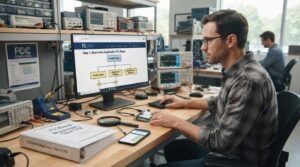
Step 1: Determine Which FCC Rules Apply to Your Product
Before anything else, identify which part of the FCC’s rules governs your device. Most consumer electronics fall under 47 CFR Part 15, but depending on your product’s function, you may also need to comply with Part 18 (industrial, scientific, and medical equipment) or other specialized rule parts.
Ask yourself:
- Does my device intentionally transmit a radio signal (Wi-Fi, Bluetooth, cellular, RFID)? → Likely requires full Certification.
- Does my device generate RF energy only as a byproduct (computers, LED lighting, power adapters)? → Likely qualifies for the simpler SDoC process.
Getting this classification wrong at the start is one of the most common — and expensive — mistakes manufacturers make. This is exactly where a compliance partner like HB Compliance adds value early, helping you correctly classify your device before you spend a dollar on testing.
Step 2: Register with the FCC and Secure a Grantee Code
Before formal testing begins, your company needs:
- An FCC Registration Number (FRN), obtained through the FCC’s Commission Registration System (CORES).
- A Grantee Code — a unique alphanumeric identifier permanently assigned to your company, which becomes part of every FCC ID your products will carry.
This administrative step often gets overlooked until the last minute — don’t let it become your bottleneck. Handle it early in parallel with product design finalization.
Step 3: Build Compliance Into the Design Phase
The single biggest driver of FCC certification success is starting early — not after your product is finished. Smart manufacturers involve compliance engineers during design, not after.
Key design-stage actions:
- Choose pre-certified RF modules where possible to simplify later testing.
- Review shielding, grounding, and antenna placement for interference control.
- Avoid components from FCC-prohibited suppliers, especially in your wireless module supply chain.
- Document your design decisions — testing labs and TCBs will want technical specification sheets later.
Fixing a compliance issue on paper costs a fraction of what it costs to redesign a finished, tooled product.
Step 4: Run Pre-Compliance Testing
Before you submit anything formally, run pre-compliance (pre-scan) testing. This internal or lab-assisted testing phase identifies potential EMI (electromagnetic interference), RF emissions, or exposure issues before they show up during official certification testing.
Pre-compliance testing typically checks:
- Radiated and conducted emissions
- RF exposure limits (MPE/SAR, where applicable)
- Frequency stability and power output
- Susceptibility to interference from other devices
Catching problems here means you fix them on your own timeline — not during a formal test cycle where failures mean re-testing fees and schedule delays.
Step 5: Test at an FCC-Recognized Accredited Laboratory
Once your product is stable and pre-compliance issues are resolved, it’s time for formal testing. If your device requires full Certification, testing must be performed at an FCC-recognized accredited testing laboratory — this isn’t optional.
When choosing a lab or compliance partner, ask:
- What’s your experience testing products similar to mine?
- What’s the realistic timeline from testing to Grant of Certification?
- Do you offer end-to-end support — including documentation, TCB submission, and labeling guidance — or just the test itself?
Working with a single partner that manages both testing coordination and TCB submission (rather than juggling multiple vendors) significantly reduces delays and miscommunication.
Step 6: Prepare Your Documentation Package
Your test results alone won’t get you certified — the FCC and TCBs require a complete documentation package, including:
- Test reports demonstrating compliance with applicable technical standards
- Product specification sheets describing design, function, and intended use
- User manuals with required compliance statements and labeling information
- Photos and internal/external device views, where required
- Block diagrams and schematics, for certain device types
Incomplete or inconsistent documentation is one of the top reasons applications get delayed at the TCB review stage.
Step 7: Submit to a Telecommunication Certification Body (TCB)
For products requiring full Certification, your application — along with all supporting test data and documentation — is submitted to an FCC-recognized TCB for review. The TCB evaluates your submission and, if compliant, issues a Grant of Certification, which is then published on the FCC’s public equipment authorization database.
For SDoC-eligible products, formal TCB submission isn’t required, but you must still retain test reports and compliance records and be ready to produce them if requested by the FCC.
Step 8: Label Your Product Correctly
Once authorized, your product must display the required compliance information — including your unique FCC ID (for certified devices) and the appropriate Class A or Class B interference notice in your user manual, depending on whether the device is intended for commercial or residential use.
Mislabeling — or skipping labeling requirements — can jeopardize an otherwise successful certification and trigger enforcement action.
Step 9: Maintain Records and Plan for Future Changes
FCC certification doesn’t expire for an unaltered product, but if you make design changes later, you may need a permissive change filing depending on how significant the modification is. Keep your test reports, documentation, and compliance records organized and accessible — you may need them years down the line.
Common Mistakes That Delay FCC Certification
- Starting compliance planning too late in the product development cycle
- Misclassifying the device (SDoC vs. Certification)
- Using uncertified or unverified RF modules
- Incomplete or inconsistent documentation
- Choosing a lab without experience in your specific product category
- Overlooking labeling and user manual requirements
Avoiding these pitfalls is the difference between a smooth certification process and months of costly delays.
Why Work With HB Compliance
Navigating FCC certification alone is possible — but it’s rarely fast, cheap, or painless. At HB Compliance, we help manufacturers, importers, and startups get their products FCC-certified the first time correctly. From early-stage classification and pre-compliance guidance to lab coordination, documentation preparation, and TCB submission, our team manages the process end-to-end so you can focus on building and selling your product — not chasing paperwork.
Ready to bring your product to the U.S. market without the delays? 👉 Get a Free FCC Certification Consultation and let our compliance experts map out your fastest path to certification.
Frequently Asked Questions (FAQs)
Q1: How long does FCC certification usually take? A: Timelines vary by product complexity, but the process typically takes anywhere from a few weeks to a few months — from pre-compliance testing through TCB review and Grant of Certification. Products with clean pre-compliance results move much faster.
Q2: How much does FCC certification cost? A: Costs depend on device type, testing requirements, and complexity. Simple unintentional radiators may cost a few thousand dollars, while intentional radiators (Wi-Fi, Bluetooth, cellular devices) with more extensive RF testing can cost significantly more.
Q3: Do all electronic products need FCC certification? A: Not all products need full Certification. Many qualify for the simpler Supplier’s Declaration of Conformity (SDoC) process instead, depending on whether the device is an intentional or unintentional radiator. HB Compliance can help you determine the correct path for your product.
Q4: What happens if I sell a product in the U.S. without FCC certification? A: Selling uncertified RF devices in the U.S. is illegal and can result in product seizure at customs, fines, forced recalls, and reputational damage with retailers and consumers.
Q5: Can I use a pre-certified module to skip full testing? A: Using a pre-certified RF module can simplify your process, but your final product typically still needs to demonstrate compliance for the host device (Subpart B testing), even if the module itself is already certified.
Q6: Does FCC certification expire? A: No — certification is generally permanent for an unaltered product. However, significant design changes may require a permissive change filing or, in some cases, a new certification.
Q7: How do I choose the right testing lab or compliance partner? A: Look for FCC-recognized accreditation, experience with your specific product category, transparent timelines, and end-to-end support covering testing, documentation, and TCB submission — not just the lab test itself. HB Compliance offers exactly this kind of full-service support.